L3 CREATIVE MEDIA


sound in film
Sound is important in film. Through its various forms, sound can establish a time period, set a mood, enhance whats already on screen, create realism, add additional information or set a mood.
Types of sound
1-
Music / Soundtrack. Music, depending on the genre and scene its applied to, can set a specific mood for a scene. This is useful as the audience knows how the scene is intended to be interpreted.
2-
Dialogue. this refers to an exchange between at least one person and something else, such as another person, a group of people, or an inanimate object like a computer.
3-
Silence. silence, or the absence of sound, is typically used in horror or thriller films to inflict fear or suspense on the viewer. The lack of any audio cues creates a tension in the audience as they don't know what's going to happen or when the silence will be interrupted.
4-
Sound effects add a new layer to what you're seeing on screen that couldn't have been achieved through visuals alone. for example, futuristic/fictional weapons and technology in films have sound effects added in post production to make them feel more real and believable to the viewer.
5-
Ambient noise. This is the background noise you hear everyday and is important in setting a scene in a film. If the scene is set in an office, you're likely to hear typing, low chatter, phones ringing and paper rustling, or if in a forest, you'll hear leaves rustling and animals scuttling about.
diegetic & non-diegetic
Diegetic sound is sound that the characters can hear as well as the audience. it can come from on or of screen depending on the source. Ambient sound and dialogue are usually diegetic.
Non-diegetic sound is sound that only the audience can hear, added in post production. Sound effects and most music are non-diegetic.
Sound bridges
pleonastic
Sound bridges are transitional tools in film that take us from one scene to another by carrying sound over from the previous scene into the next. this creates a more seamless transition and makes cuts feel less jarring, but they can also be used to make a point.
Pleonastic sound is sound that would already belong in a scene that has been exaggerated, like being able to hear someone sit in a leather chair, or hearing a tap drip. This helps increase meaning or emotion in a scene.
Contrapuntal
Foley sound
Contrapuntal sound is sound that juxtaposes the mood of the scene. Typically used to elicit an emotion from the viewer, contrapuntal sound is often a case of adding uplifting, light-hearted music to a scene that very much isn't. This can create a sense of sympathy from the viewer, as they try to recognise the disturbing with the comforting
Foley sound is the art of creating and recording 'everyday sounds', such as footsteps or knocking, that are then added into a scene post production. Foley enhances the listening experience of a film.
Premier pro
This is the sequence i was working with. I set out to correct the canted angle and make it look level.

By entering the motion settings through effect controls, i was able to change the rotation of the frame. However, this left me with empty space at the edges of the frame

To fix this, I increased the scale, effectively zooming in so that the image fills the frame.

Had I not marked and cut the section I wanted to edit, this change would've been made to the entire clip. First, I needed to mark the first frame of the clip I'm editing, as well as the first frame of the following clip, by pressing "m". When it came to isolating my clip, I selected the razor tool and cut the clip on the markers. This assures that any alterations made will be to this section only, as long as its selected.


marker (green)
Razor tool
The colours in this scene are tinted a green-y blue. To correct this I opened the colour workspace in order to access the colour wheels.

Moving the crosshair on the wheel in the opposite direction to the pre-existing tint helps balance the colours and bring out more natural tones.


colour grading
Colour grading is the stylistic choices made post-production in order to add a mood or atmosphere to a scene.
For this sequence, I lowered the exposure and highlights in order to create a darker atmosphere, as well as adding a cooler temperature.


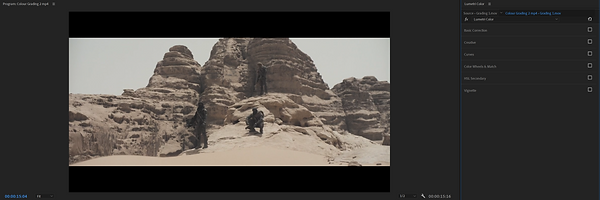
For this sequence, changed the hue, exposure, contrast and added a vignette. it looks a lot brighter, like the desert location they're in has the sun beaming down on them.


For this sequence, I reduced the exposure and highlights, along with increasing the contrast and saturation. I also warmed the temperature of the image since it seems like they're in a desert of some kind.

interviews
We were asked to conduct interviews between us, alternating roles between interviewee, sound person and interviewer.


I operated and managed the boom mic and sound in this interview.
I am the interviewee in this interview.
I operated the camera and asked the questions in this interview.
Overall, I think the interviews went well. The sound is clear - despite not being the greatest quality - and I think we got the headroom to the right amount. We tried to add some "props" on the table in the back to fill out the space a little, which I think helped.
Next time, maybe we could film with the subject a little more centred in the frame.
Continuity editing
This is the kind of editing meant to go unnoticed by the audience to keep the continuity and flow of the screen uninterrupted.